SSP Cast HU
SSP's HU series produces a narrow bimodal particle distribution. In filter, the cup leans clean with a tea-like body and the delicate aromatic detail standard burrs tend to blur. In espresso the distribution shifts the cup toward fuller body with clear flavor separation.
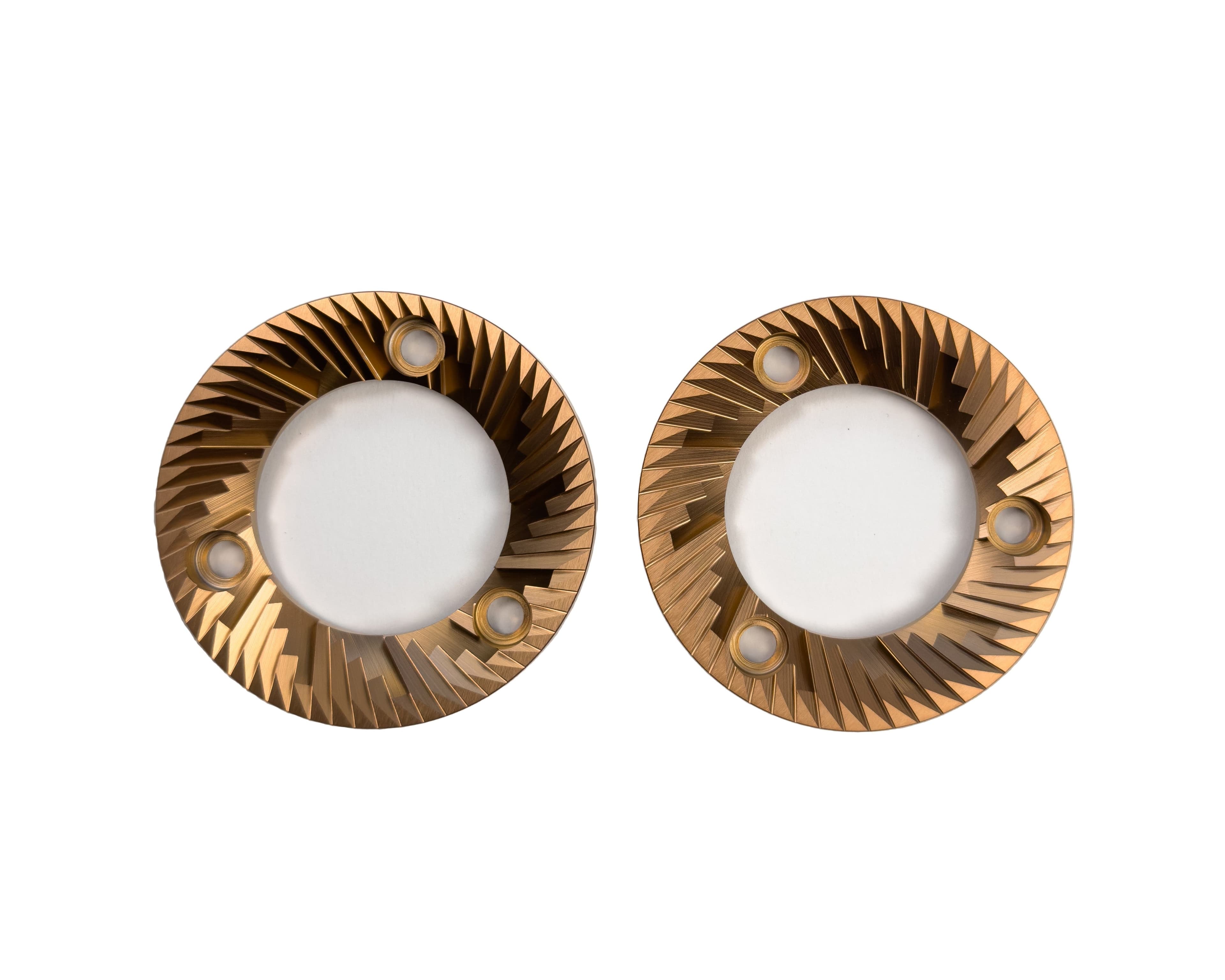
- Maker
- SSP
- Geometry
- Flat
- Sizes
- 64mm / 83mm / 98mm
- Material
- Cast steel, hardened
- Coating
- Uncoated or Red Speed (TiN)
- Particle profile
- Narrow bimodal
Flavor profile in the cup
The axes show the direction the burr leans toward. Higher values mean that quality stands out more than average; lower values mean it comes through lighter.
Sizes & compatible grinders
The most common SSP HU size. Fits the majority of single-dose home grinders. The narrow distribution is most pronounced at this scale.
- ·Option-O Lagom P64
- ·DF64 / DF64v / DF64 Gen 2
- ·Mazzer Super Jolly (with adapter)
- ·Niche Zero (with conversion kit)
- ·Eureka Mignon Specialita / Oro / XL
- ·Fellow Ode (Gen 2, with conversion)
- ·Mazzer Philos
- ·Weber Workshops Key (with adapter)
Released after 64mm gained traction. Retains slightly more body than 64mm because of the larger surface area, while keeping a similar uniformity profile.
- ·DF83
- ·Niche Duo
- ·Compak F8
- ·Anfim SP-II
The original size that earned SSP its reputation. Standard for café pour-over stations. More body and flavor separation than 64mm or 83mm.
- ·Mahlkönig EK43 / EK43S
- ·Mahlkönig EK Omnia
- ·Option-O Lagom P100
- ·Anfim SP-II
- ·Compak R100
Background & overview
SSP's HU series was engineered around a single goal: a narrow bimodal particle distribution.
In standard burrs, coffee particles pass through two or three cuts on their way through, and the final distribution is wide. Large particles produce uneven extraction; tiny fines cause over-extraction and bitterness. HU's engineering aims at a single clean cut per particle. The result is a narrow distribution: most particles clustered at one size, with a small fraction of beneficial fines that aid extraction.
The cup in filter
Every particle extracts at the same rate. The cup comes out clean with a light body, often described as "tea-like". Floral aromas and the ability to distinguish nuance between specific varieties stand out more clearly than with standard burrs. Acidity stays clean but doesn't peak, since the narrow distribution trims both the upper and lower edges of the spectrum. Coffee that's a touch under, or with roast defects, shows through more here than with wider-distribution burrs.
The cup in espresso
The behavior flips here. The narrow distribution produces a denser puck with higher resistance, which translates into relatively full body and a profile users often describe as "chocolatey". With medium and darker roasts the result is closer to a classic espresso with greater flavor separation than a standard burr. With very light roasts the outcome depends on pressure and temperature.
The technology
The teeth are thinner and denser than typical, so the steel must be hardened to hold shape over time. Two versions are available: uncoated, and Red Speed with a titanium nitride coating. The coating extends burr life significantly (around 1500kg vs ~800kg uncoated). Some users report a small flavor difference between the two, others don't. Casting tolerance is 0.005mm, an industrial grade.
The difference from MP
Both series come from the same family but lean differently. HU has a narrower distribution, so in filter the cup is cleaner but body lighter. MP offers a slightly wider spectrum with more acidity in espresso and more nuance, at the cost of a bit of clarity. The difference isn't in tier — it's in direction.
Quick details
- ·Notably narrow bimodal distribution. Clarity stands out, body in filter is very light
- ·In espresso the behavior flips: the cup comes out fuller with high flavor separation
- ·Acidity is clean but doesn't peak. MP offers more pronounced acidity
- ·Optional Red Speed (TiN) coating roughly doubles burr life (~1500kg vs ~800kg uncoated)
- ·0.005mm casting tolerance, an industrial grade
- ·In 64mm popular in single-dose home grinders; 98mm is the EK43 standard